

Do you often find yourself slouching at your desk, feeling stiff after a long day, or struggling with low energy in the morning? Many of us experience these common issues, and they can take a toll on both our physical health and mental clarity. Luckily, there’s a simple yoga pose that can help: Tiryaka Tadasana, also known as the Side Stretch Pose.
Despite its simplicity, Tiryaka Tadasana is incredibly powerful. It stretches and strengthens your spine, tones your core, improves posture, and even helps relieve tension and stress. Incorporating this pose into your daily routine can be a game-changer, providing a natural boost to both body and mind.
What is Tiryaka Tadasana?
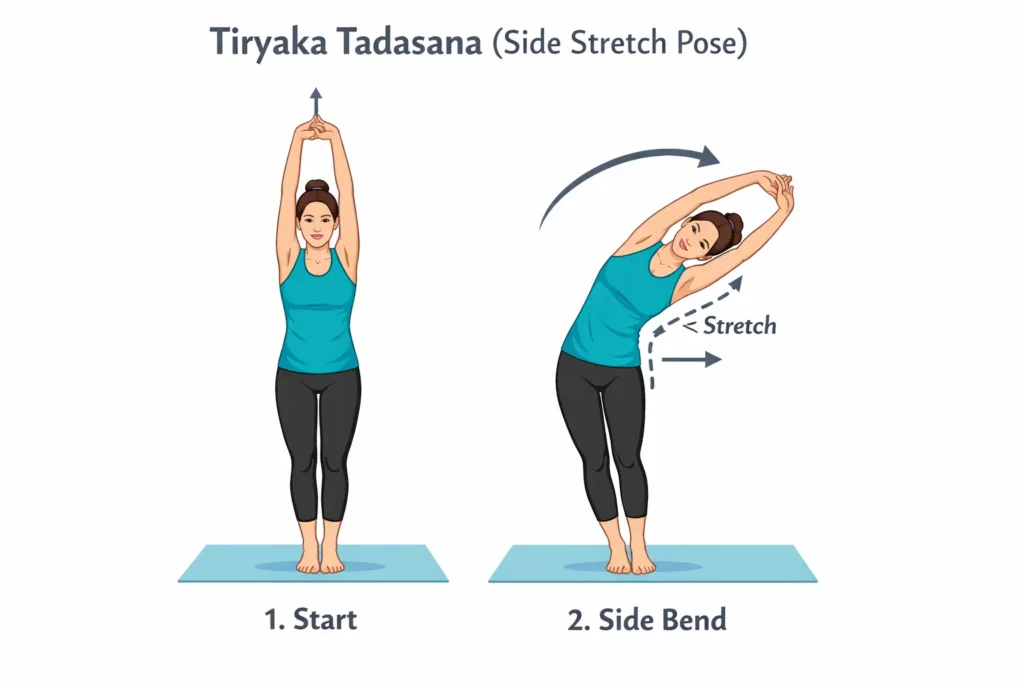
Tiryaka Tadasana is a standing side-stretch yoga pose that focuses on elongating the spine and opening up the sides of the body. The name comes from Sanskrit: “Tiryaka” means “side” and “Tadasana” means “mountain pose.” Essentially, it’s a side-bending variation of the foundational Tadasana, combining balance, stretch, and gentle core engagement.
Traditionally, Tiryaka Tadasana has been practiced to enhance spinal flexibility, improve circulation, and cultivate a sense of alert calmness. It’s accessible to beginners yet offers benefits that experienced yogis can appreciate.
For beginners, imagine standing tall like a mountain, interlacing your fingers overhead, and gently bending to one side while keeping your feet grounded. This motion stretches your sides and opens your chest, creating a refreshing full-body stretch.
Step-by-Step Guide to Perform Tiryaka Tadasana
Tiryaka Tadasana may look simple, but doing it correctly maximizes its benefits while keeping your body safe. Follow these detailed steps for an effective side-stretch routine:
- Stand tall in Tadasana (Mountain Pose)
- Place your feet together or hip-width apart, whichever feels more stable.
- Ground your feet evenly, feel the weight distributed on the heels and balls of your feet.
- Relax your shoulders and keep your spine elongated. Stand like a strong mountain, steady and firm.
- Interlace your fingers and stretch your arms overhead
- Inhale deeply and bring your arms above your head, interlocking your fingers.
- Keep your biceps close to your ears, and gently stretch upward, feeling the lengthening from your heels to your fingertips.
- This upward extension activates your spine and engages your core even before the side bend.
- Exhale and bend sideways from the waist
- Slowly lean to the right, keeping your hips grounded and aligned.
- Imagine stretching your body like a bow, reaching through your fingertips while your feet stay rooted.
- Avoid collapsing your chest forward or backward; the motion should be a smooth sideways stretch.
- Hold the pose and breathe deeply
- Stay in the position for 15–30 seconds, or longer if comfortable.
- Breathe evenly, feeling the expansion along your ribs, waist, and sides.
- Focus on lengthening the spine and opening the side body, rather than forcing yourself deeper.
- Return slowly to center and repeat
- Inhale as you slowly return to the upright position.
- Exhale and repeat the stretch on the left side.
- Perform 2–3 rounds on each side for a balanced, energizing stretch.
Tips for Proper Alignment and Avoiding Mistakes:
- Keep your core engaged to support the spine during the side bend.
- Ensure your torso moves strictly sideways—avoid twisting or leaning forward/backward.
- Maintain soft knees; locking them can strain the lower back.
- Listen to your body—stretch gently and only as far as comfortable.
Optional Variations for Different Skill Levels:
- Beginner: Stand next to a wall for extra balance support, or use a yoga strap if your fingers don’t interlace comfortably.
- Intermediate: Add a slight backbend while side stretching for a deeper spinal extension.
- Advanced: Lift your heels slightly or perform the pose on a yoga block to challenge balance and increase engagement of stabilizing muscles.
Top Benefits of Daily Tiryaka Tadasana
Adding Tiryaka Tadasana to your daily yoga routine can produce transformative results for both body and mind:
- Improves flexibility: Stretching the sides of your torso, spine, and core muscles helps increase overall flexibility. Regular practice can reduce stiffness, making daily movements easier and more comfortable.
- Strengthens core and obliques: The side-bending action engages abdominal muscles, obliques, and even stabilizing muscles in your back, contributing to a stronger, more balanced core.
- Enhances posture: Sitting for long hours can lead to slouching and rounded shoulders. Tiryaka Tadasana counteracts this by opening the chest, lengthening the spine, and training your body to maintain an upright, confident posture.
- Boosts digestion and circulation: Gentle compression of internal organs during the side stretch can stimulate digestion. Improved blood flow from standing stretches energizes the body and promotes overall wellness.
- Relieves stress and fatigue: This pose encourages deep, mindful breathing while stretching the body. The combination of movement and breath reduces tension, promotes relaxation, and helps combat mental fatigue.
- Promotes a sense of energy and balance: Starting or ending your day with Tiryaka Tadasana can leave you feeling refreshed, balanced, and mentally focused. It’s a perfect way to energize your body without intense exertion.
How to Incorporate Tiryaka Tadasana into Your Daily Routine
Adding Tiryaka Tadasana to your daily schedule doesn’t have to be complicated. With a few simple strategies, you can enjoy its benefits consistently:
- Morning wake-up stretch
- Start your day with 2–3 rounds of Tiryaka Tadasana to gently wake up your muscles and spine.
- This side stretch helps improve circulation, energizes the body, and sets a positive tone for the day ahead.
- Start your day with 2–3 rounds of Tiryaka Tadasana to gently wake up your muscles and spine.
- During work breaks to relieve stiffness
- Sitting at a desk for hours can lead to tight hips, shoulders, and spine.
- Stand up, stretch your arms overhead, and perform a couple of side bends to release tension.
- It’s a quick and effective way to refresh both your body and mind without leaving the office.
- Sitting at a desk for hours can lead to tight hips, shoulders, and spine.
- As part of a daily 10–15 minute yoga sequence
- Combine Tiryaka Tadasana with other standing poses such as Tadasana (Mountain Pose), Trikonasana (Triangle Pose), and simple forward bends.
- Performing a short sequence daily reinforces flexibility, posture, and balance.
- Combine Tiryaka Tadasana with other standing poses such as Tadasana (Mountain Pose), Trikonasana (Triangle Pose), and simple forward bends.
- Tips for beginners
- Start slow—perform 1–2 rounds per side initially, holding the stretch for 10–15 seconds.
- Gradually increase the duration and number of repetitions as your flexibility improves.
- Focus on maintaining correct alignment rather than trying to bend as far as possible.
- Start slow—perform 1–2 rounds per side initially, holding the stretch for 10–15 seconds.
Precautions and Who Should Avoid It
While Tiryaka Tadasana is generally safe for most people, some precautions are important:
Consult a doctor if you have severe back or spinal injuries
- People with herniated discs, severe scoliosis, or other spinal conditions should seek medical advice before performing side stretches.
Avoid over-stretching or holding your breath
- Stretch only to a comfortable point and breathe steadily to avoid strain or dizziness.
Modify using a wall or chair if needed
- Beginners or those with balance issues can perform the pose next to a wall or hold onto a chair for support.
- Using props ensures safety while still gaining the benefits of the stretch.
By following these simple incorporation strategies and safety tips, Tiryaka Tadasana can become a reliable, energizing part of your daily routine.
Expert Tips for Maximum Benefits
To get the most from Tiryaka Tadasana, focus on breath, alignment, and consistency. Pairing the pose with deep, mindful breathing enhances both its physical and mental benefits. Inhale as you reach your arms overhead to lengthen the spine, and exhale as you bend sideways, letting the stretch deepen naturally. This connection between breath and movement improves flexibility, relieves tension, and promotes calmness.
For a more complete practice, combine Tiryaka Tadasana with other standing stretches such as Tadasana (Mountain Pose) or Trikonasana (Triangle Pose). Flowing through these poses strengthens your core, opens the chest, and improves balance, creating a full-body routine rather than an isolated stretch.
Finally, prioritize consistency over intensity. Practicing the pose for just a few minutes each day is more effective than occasional long sessions. Focus on proper alignment, gentle movement, and steady breath. Over time, this approach builds strength, flexibility, and mental clarity while reducing the risk of strain or injury.
Quick Tip: Start with 2–3 minutes daily and gradually increase as your body adapts.
Conclusion
Tiryaka Tadasana is a simple yet powerful yoga pose that offers a wide range of benefits—improving flexibility, strengthening your core, enhancing posture, boosting circulation, and relieving stress. Its accessibility makes it ideal for beginners while still offering depth for experienced practitioners.
By incorporating Tiryaka Tadasana into your daily routine, even for a few minutes each day, you can notice improvements in physical alignment, energy levels, and overall well-being. Start small, stay consistent, and allow your body to adapt naturally.
Try including Tiryaka Tadasana in your morning routine for at least a week and see how your body responds. Share your experience in the comments, or follow along with a guided video to perfect your form and alignment.